Monday, May 20, 2013

The Mountain, the Monastery, and the Moreneta

This post is the first in a three-part series about my recent travels through Spain.

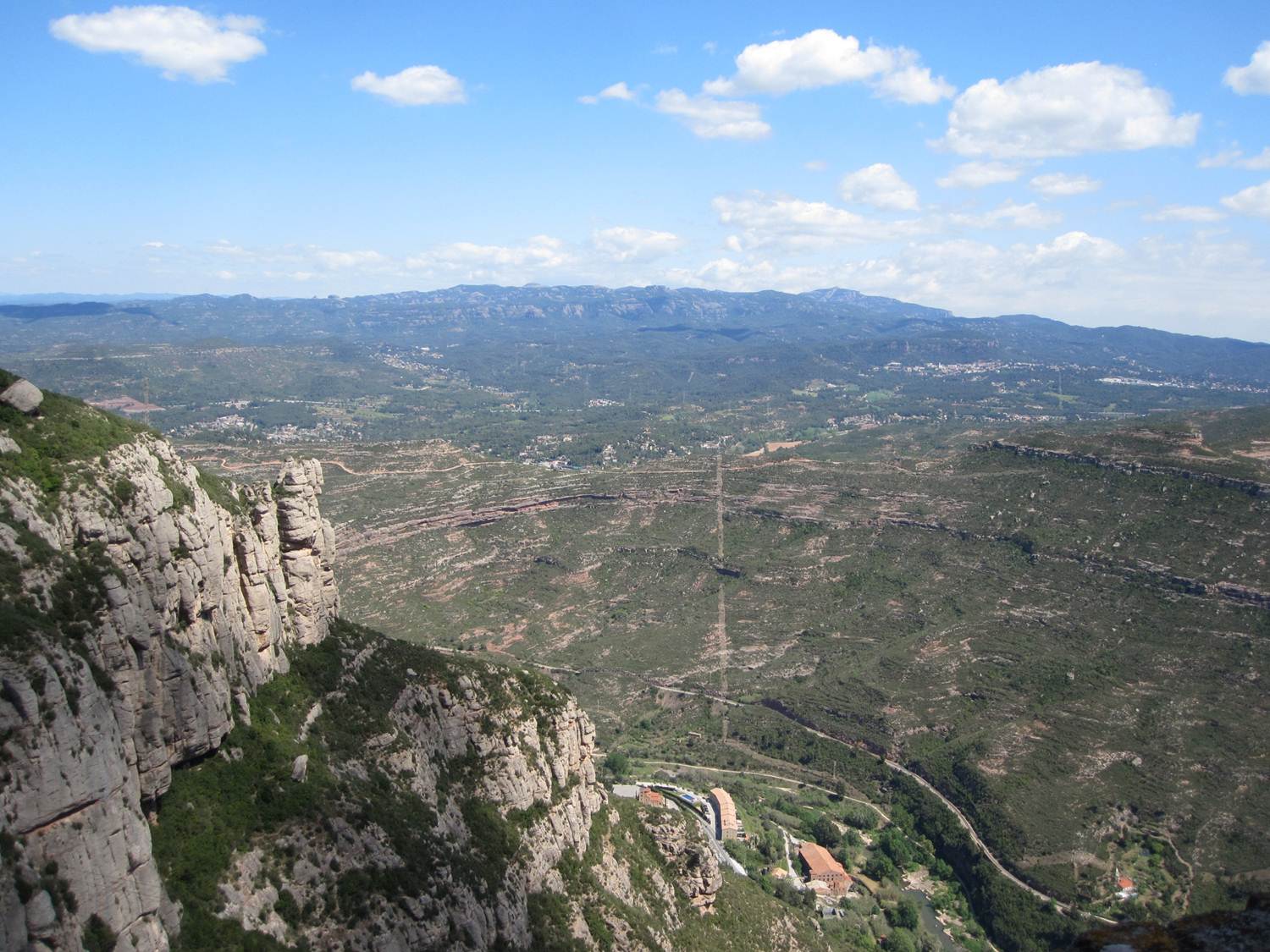
View of the Santa Maria de Montserrat
Abbey from the Santa Cova Trail.
One day, while planning my trip to the Barcelona area, I was flipping through an English Baedeker guidebook on Spain. I just happened to thumb by a page with a picture of a very odd looking mountain. There was something about it that drew my attention, almost as if I were being pulled toward it. When I read the details and discovered that it was called Montserrat, and that it was in the Barcelona area, I immediately decided I needed to visit there. Fortunately, I was staying with some good (Spanish) friends of mine in the Barcelona area who lived not too far off and on a breezy yet sunny Sunday, we drove to Montserrat.

Montserrat as viewed from the nearby city of
Manressa (Wikimedia)
.
The name "Montserrat" literally means "serrated mountain" in the Catalan language. Seeing the jagged shapes jutting out from the already hilly Catalonian landscape, it wasn't hard to see how appropriate this name was. Montserrat's significance goes far beyond just being an unusually shaped mountain, however. The mountain is also home to a very famous Benedictine Abbey, Santa Maria de Montserrat, the rich history of which I'll describe a bit later.

My friends and I arrived at the base of the mountain, where we boarded the rack railway (Catalan: cremallera) that leads up the mountain to the monastery. Despite being near the top of large mountain literally in the middle of Catalonian countryside, the monastery is surprisingly well connected. It can be reached by not only by the rack railway but also by cable car, funicular, various roads, and by foot; extensive hiking trails cover the area. 
Rack railway/funicular station near the monastery.


For many reasons, Montserrat is one of the most popular tourist sites in Catalonia. This point, combined with clear, lovely weather meant many visitors were also around. The crowds, however, were still quite tolerable and nothing close to the ridiculous and rowdy tourist throngs that one finds in certain areas of Barcelona. As I had discovered days earlier, the stories about that city overflowing with tourists are quite true. Walk around the Barri Gòtic, Cuitat Vella, or especially the Ramblas, and you'd be hard pressed to find anyone who isn't a tourist.

A closer view of the Santa Maria monastery.
After enjoying some of the great views, my friends and I decided to head into the abbey itself and specifically to view the Virgin of Montserrat aka la Moreneta ("little dark-skinned one"), an extremely famous icon of a dark-skinned Virgin Mary holding the baby Jesus in her lap and a golden orb in her right hand. There are many legends associated with this lovely little statue. One states that the figure was carved by St. Luke and eventually brought from Jerusalem to Barcelona. It was then hidden away on Montserrat to protect it from Muslim invaders during the 8th century CE. Forgotten for centuries, it was rediscovered during the Reconquista and a monastery built on the mountain.

Drawing of the Moreneta
at the Santa Cova
chapel.
Another, perhaps more popular legend about the Moreneta, goes back to the year 888 CE. Some shepherds in the countryside had seen a very bright light coming from the mountain. They informed the local bishop, who lead an expedition up to the mountain. Following the light, the party entered a cave where they discovered the Moreneta. They decided to bring the icon down from the mountain into the local city for people to worship it but as they carried the statue, it gradually became heavier and heavier until it could no longer be carried. The bishop interpreted this as a sign that the Moreneta would be worshpped where it was found: on the mountain itself. Not long after, the monastery was built to house it.

What does modern science say about the statue? Tests have shown the statue was made in the 1100s, which is consistent with its Romanesque style. Further studies have shown that the "little dark-skinned one" was originally white, but started to darken in the 1500s due to the lead-based paint that was originally used. In the 1700s, it was painted entirely black. While we have an understanding of the physical composition of the statue, its actual origin is still unclear. Where exactly did it come from and who actually carved it? Who put it all the way up in the mountain? The answers to these questions seem to have flowed away in the river of time. What we can say is that the Moreneta quickly became a symbol of the region and has long been the patron saint of Catalonia, making Montserrat itself the spiritual center of the Catalan people. Veneration of the Moreneta was then literally spread around the world during the  Spanish colonization of the Americas. On the day of my visit, I did indeed see a fair number of pilgrims from Latin America.

The line to visit the Moreneta was quite long but did move at a fair pace despite Sunday Mass being held. Inside the main courtyard, messages of welcome and blessing were posted in pretty much every major world language.

Welcome to Montserrat.
Just about to enter the basilica.


The line of visitors slowly ambled its way through the side of the basilica and up through a set of beautifully decorated stairs. The path eventually led to a small shrine room that was right above the main altar of basilica and in this room was the legendary Moreneta, peacefully sitting behind a glass case with the orb exposed. As one of my friends joked beforehand, "You know how it is with Catholics, you always have to touch or kiss something". Indeed, many (but certainly not all) visitors did touch or kiss the orb. All the people I saw who kissed the orb did wipe it down with a tissue before and after, which made the whole thing much more hygienic than it might seem. I too decided to pay my respects and I gently touched the orb.

Literally touching history made me think about how many other people through the ages have been through to see the Moreneta. Perhaps one the most famous was a Basque soldier who made a pilgrimage to Montserrat in the early 1500s. After recovering from war wounds, he stood before the Moreneta, threw down his weapons, and swore to serve God and the Church. This man's name was the Ignatius of Loyola and he would later go on to establish the Society of Jesus, better known as the order of the Jesuits.
  
A view of the altar in the Santa Maria basilica. The stream of visitors to see the Moreneta can be seen on the lower right-hand side while the Moreneta shrine can be see in the upper-left. The boys choir of Montserrat is quite well known and was practicing when I took this photo.
 
Behold the Moreneta!
Offerings from devotees.

The path from the Moreneta shrine leads to a narrow passage filled with candles and shrines. The many pilgrims who visit here leave not only candles but also messages of faith and devotion, which were posted on a very large board. From what I briefly saw, the stories often involved people praying to the Virgin of Montserrat and, having received divine assistance, making a pilgrimage to the mountain as a way of showing their gratitude. 

Having seen the Moreneta, my friends and I decided to check out the place where the legend of Montserrat really began, the Santa Cova ("Holy Grotto" in Catalan). We took a funicular down the side of the mountain and walked along a path called the Santa Cova Trail. Along it, one finds various sculptures and shrines that depict various episodes from the life of Jesus. Aside from the lovely art, there are also absolutely stunning views of the surrounding area.

Sculpture along the
Santa Cova trail.


At this particular time, we could see all the way to the Pyrenees (not shown here).
At the end of the Santa Cova trail lies the small Santa Cova chapel. This humble structure was built around a small grotto where, according to legend, the Moreneta was first discovered. A replica of the Moreneta remains in the grotto. Only a handful of visitors were around and the place was very calm and quiet, which was very different from the buzzing activity in and around the basilica.

 
The actual Santa Cova with a
replica of the Moreneta.
The Santa Cova chapel.


View of the monastery
from the Saint Jeroni
funicular station.
Various hiking trails near the
Montserrat's summit.
After strolling back from the Santa Cova and popping into the basilica (Mass was over by now), we took the funicular to the top of Montserrat, an area called Saint Jeroni. In theory, vistas even more amazing than those from the Santa Cova trail were up there but some clouds and a rather chilly breeze had started to roll through, obscuring the views somewhat. Apparently, from the very summit from Montserrat on a clear day, one can see all the way to Mallorca. We didn't hike up that far but we did have some more lovely views. We saw many hikers and climbers in addition to the casual visitors like my friends and I. Along some of the trails were very old hermitages and chapels that had been built and maintained by, well, hermits. Following one of the many winding paths, we went stopped off at the hermitage of Saint Onefre. The image of this place on the top of the mountain and amongst the clouds is one of my favorite pictures of my entire Spanish trip. Looking down at the world below while breathing the pure mountain air and listening to the cool breeze blow was quite an experience. I might be a city boy, but I can definitely appreciate getting back to nature every now and then.
 
The hermitage of Saint Onofre.
How to saw a mountain over millions of years. 
Having satisfied ourselves with a mountain-top paseo (the Spanish term for "leisurely stroll"), we waited around for the funicular to take us back down to the monastery. While waiting, we had a look at the exhibition at the Saint Jeroni station. Aside from recounting the history and many legends surrounding Montserrat, there was also a very interesting science exhibition. For the science nerds reading this, there was also lots of geological information about the area, including how the mountain got its famous serrated shape.
Back down at the monastery, we checked out the museum as well as the gift shop. I was impressed by the very fascinating and well-done exhibition on the history of Montserrat and its place in Catalan culture. I was even more impressed by the gift shop. Aside from the usual souvenirs (magnets, post cards, etc.) there was also a rather impressive collection of books in Catalan. And it wasn't just a selection of books about Catholicism or Montserrat. The shop had books on a large variety of topics ranging from Catalan cuisine to Zen meditation! On a related note, the monastery itself has a long and distinguished publishing history and houses one of the oldest continuously operating publishing houses in Europe (est. 1499).

At the end, we took the funicular back down and as we drove home and the landscape started to glow with the golden rays of the setting sun, I thought about just how special Montserrat is. It's so many things, all at once: a holy pilgrimage site, a paradise for hikers, and a fascinating object of study for scientists. Back when I was planning this visit, I was expecting just an old monastery on top of a weird-looking mountain. While I did find an old monastery on top of a weird-looking mountain, I was surprised at what else this place has to offer. But then again, being pleasantly surprised is one the things I enjoy most about traveling. Perhaps I'll return to Montserrat and again be pleasantly surprised at what else I can find on this holy mountain.


Sunday, March 10, 2013

Rivers of Offerings

The Buland Darwarza (Gate of Magnificence)
at Fatehpur Sikri
.
During our first conversation about a trip to India, the first thing my mother asked was, "When do we visit the Taj?" Obviously, one can't make the long trip to India and NOT visit its most famous landmark, right? And so we planned to visit Agra, the city where the famous Taj Mahal is located, as part of a long day trip from Delhi. 

We arranged for a car and driver for the day and we were up and out at about 6am. Navigating through Delhi's clogged streets, even at such an early hour, was quite a tedious experience but our driver handled it well. Once we cleared the city, it was mostly clear sailing. There wasn't much in the way of the scenery but we did pass through the city of Mathura, which has a rich heritage that includes being the legendary birthplace of Lord Krisha as well as being home to some of the earliest buddha images.

As traffic is not allowed near the Taj Mahal grounds, our driver dropped us off at one of the paths leading to the entrance. Touts of all sorts were hocking various modes of transportation; everything from human-pulled rickshaws to tacky-looking camel- or ox-pulled carts. My mother and I instead decided to be hardcore and make the ten minute trip on foot. Along the way, we were approached by a kid, about seven years old, selling various trinkets. The exchange went something like this:

Kid: (looking at my mother) Do you come from France?
My mom: (puzzled but looking very chic in a mostly black ensemble and wearing sun glasses) No, I'm not from France.
Kid: Oh, but you are looking like very high-class, madam!
My mom: (somewhat offended but laughing nonetheless) How come you're not in school?!
Kid: I can't go to school. I must work here instead.
My mom: But you speak very good English for someone who doesn't go to school!
Kid: (awkwardly speechless)
My mom: (relenting) OK, I'll take one of these little ornaments here.

India is full of all kinds of characters and this kid was certainly one of the nicer and more memorable ones. He was very happy we bought some stuff and he wished us well on our visit. 

Lining up for the Taj.
Darwarza-i rauza (The Great Gate).
There was certainly a big line at the entrance, which was expected. What wasn't expected was such tight security. Everyone had to pass through two metal detectors and was frisked. Many were even pulled aside for additional screens, but fortunately my mom and I had no problems. Getting through here was tougher than the security at most airports I've been to. Afterward, we were treated to a nice view of the Darwarza-i rauza, itself a lovely example of Mughal architecture. Passing through such a grand structure already put me in the mindset to experience one of the most memorable views of my entire life:


The Indian poet and polymath Rabindranath Tagore once famously described the Taj Mahal as a "teardrop on the cheek of eternity". Looking at it from the Great Gate, I couldn't agree more. Funnily, my initial views on the Taj were quite skeptical. The Taj Mahal, oh the Taj, beautiful India, new wonder of the world, blah, blah blah. In some ways visiting the Taj Mahal is such a cliche, something you have to do in India. Heaven help those who travel to India and don't visit the Taj Mahal. They must endure having suffered an "incomplete trip" and such a tragic case can only be remedied by returning to visit the Taj. All those feelings were blown away in an instant as soon as I laid eyes on the Taj Mahal. Like India itself, no amount of reading, studying, planning, or researching can ever compare to actually being in the midst of it all.

A closer view of the mausoleum.
And now for a (very) brief history of the Taj Mahal. It was built in the mid-1600s by the Mughal emperor Shah Jahan as a mausoleum for his beloved wife Mumtaz Mahal. The entire complex was constructed over a period of 22 years. In Islam, Paradise is described as a heavenly garden and the design of the Taj Mahal complex (in addition to many other sites around the Islamic world) reflect this. While there are many myths and legends surrounding the construction, few are actually true and most others are hard to verify. In any case, all that can be said for certain is that the the finest architects and tens of thousands of craftsmen working with the finest materials from the entire empire (which at this point basically encompassed all of the Indian subcontinent) were used. Upon his death in 1666, Shah Jahan was interred next to his wife. In the centuries that followed, the Taj Mahal became famous far and wide and today is certainly the most famous and most visited site in India.

An uncommon perspective: a view
from the Taj Mahal overlooking the
gardens and the Great Gate.
Wandering around the mausoleum.
Although there were many tourists about, the open space and somehow soothingly symmetrical layout of the area made the feel very serene. My mother and I gradually made our way though the gardens and then to the mausoleum itself. Included with our tickets were shoe covers that were basically cloth bags that fit over one's shoes. Walking with on to the mausoleum with "bare" shoes is not allowed. In contrast, most of the Indian visitors simply went shoeless.  There was an intriguing mix of people at the Taj. Although the division between Indian and non-Indian tourists was an obvious one, I observed that there were some distinct categories of people which transcended nationality. For example the adventurous travelers (I'll put my mom and myself in this category), scholars of various sorts examining the minutiae, big families on epic family vacations, and my personal favorite, couples young and old visiting one of the greatest monuments to romantic love ever built. It's one thing to see starry-eyed newlyweds spinning in each other's arms but it was quite endearing to see old couples who had been married for decades still having that ever so slight spark between each other. My mother and I both wound up taking pictures for various people while others happily obliged us by taking photos of us. If you're traveling alone in an unfamiliar place and want a picture of yourself, just ask another tourist. Many people inside of the itself tomb were snapping tons of photos, something which is not officially allowed, but I didn't even bother. Not only could I not hope to capture the beauty of the interior with my little handheld camera, I also felt such behavior was quite disrespectful. Aside from breaking an obvious rule on common decency, would people carry on in such an obnoxious way if Shah Jahan himself were alive and walking around there?

Tomb interior with the coffins of emperor Shah Jahan and his
beloved Mumtaz Mahal (Wikimedia).

The mosque.
In keeping with the religious tone of the site, the Taj Mahal complex also hosts a mosque. It is located on the western side of the mausoleum and is built in typically Mughal style using red sandstone. To preserve the symmetry of the site, a replica "mosque" was built on the eastern side. While this building looks very similar, it is not actually a mosque since it doesn't have a mihrab (prayer niche facing the direction of Mecca). 


The mihrab, facing Mecca.


The mosque interior.
Interior of the main dome.


Sterotypes come from somewhere; cows
are everywhere in India.
We spent longer than expected at the Taj but every moment there was wonderful. Eventually it was time for us to head out but I took one last look (and one last photo) before we left. We gradually retraced our path to the main gate and while waiting for a crowd of people to pass, I had the feeling someone was looking over my shoulder. I slowly turned around and saw a cow very leisurely standing quite close to me. I looked at it and it looked at me. And on some level, I think we understood each other.

My mother and I somehow got a bit lost in trying to find our way back to where our driver had parked (OK, it was my fault...). We went back toward the Taj when we saw the same little kid we had encountered earlier that day. Seeing we were a bit lost, he enthusiastically pointed us in the right direction. "Please! You must go this way! This is the right way! Remember, we met this morning! I am your friend, you can trust me!" Indeed he was and we found the way on his suggestion.

Normal Indian traffic.
At this point, we met up with our driver, who asked if we were hungry and then dropped us off at a nearby restaurant. The story of the restaurant and of our next stop on the trip, the mighty Agra Fortress, is a tale for another time. For now, I'll skip ahead to the final destination of the day, which was the old city of Fatehpur Sikri. Or at least that was the plan.

Fatehpur Sikri is a planned city built by order of the Mughal Emperor Akhbar, who was not only the greatest ruler of the Mughal era, but also one of the most progressive and tolerant rulers in Indian history. Originally intended as a new capital city, the site was abandoned after only 14 years because of water shortages. The city became a ghost town once the imperial court left and now has some of the best preserved examples of Mughal art and architecture anywhere while continuing to draw a steady stream of tourists.

The great sandstone staircase...
As Fatehpur Sikri is located outside of Agra's city limits, we had a little bit of a drive. At this point, the sun had just started to go down and my mom and I were feeling a bit beat from all the running around. Our driver parked in a lot that was across the street from a very large red sandstone staircase. I was a bit puzzled because this wasn't exactly the entrance I was expecting based on my trip planning. Actually, I wasn't exactly sure where the heck we were. I couldn't figure it out based on the maps I had, but the "Fatehpur Sikri signs" did reassure me we were theoretically at the right place. Nonetheless, we made our way to the top of the staircase and were surprised at the big buzz of activity there. Lots of people were going in and out of the massive and intricately designed gate. When I saw that those who were going in were taking off their shoes and depositing them with a pot-bellied, elderly attendant with a long white beard, I realized just where exactly we were: the tomb of the Sufi saint, Salim Chishti, at the edge of Fatepur Sikri. Our driver had dropped us off at the "wrong place" since we weren't close to the abandoned city as originally planned. Far from being a disaster, this turn of events would later become a blessing. 

The busy scene at the top
of the stairs.
And now for some cultural background. Sufism can basically be described as a mystical and meditative approach within Islam rather than as separate sect and its followers can be all over the Islamic world. The Sufi tradition has an especially rich and vibrant history in South Asia and has had a large influence on the wider (non-Islamic) culture as well. As for Salim Chishti himself, he was a revered Sufi master and contemporary of Akhbar the Great. In fact, Akhbar's reverence and devotion to Salim Chisti was so great, he specifically chose the location of Fatehpur Sikri to honor him. The legendary Sufi saint was known for his great emphasis on generosity and religious tolerance. He exhorted his followers to "develop river-like generosity, sun-like affection, and earth-like hospitality". These teachings also rubbed off on Akhbar himself, as tolerance and generosity were two things that he became well known for.

I had previously visited some old mosques in Delhi but this was my first time visiting a dargah, which is shrine built around the tomb of a Sufi saint. I was both intensely curious and really excited. As soon I passed through the mighty gate (the Buland Darwarza), I began to feel very...calm. Being a living spiritual center, the whole vibe of this place was very peaceful and relaxed. The fact that it was dusk, the time of the day when I feel especially calm and settled, also added to the serene impression.

The Gate of Magnificence.
A front view of the gate.

A wide shot of the Salim Chishti dargah. The tomb itself is the white marble structure.
Worshiping in progress.
Although I had originally planned for us not to visit this place, I immediately realized that our visit here couldn't have been more serendipitous. After a long, tiring day of sightseeing and navigating through tourist hordes, a spiritually nourishing place like this was exactly what I needed. It wasn't 100% peaceful, however. A couple of "tour guides", one about 15 years old and the other about 12, approached my mother and I and aggressively offered a "complete information tour of the holy site for a best price". At first we politely refused but they were still quite determined to force their services on us. We simply ignored them. After a nearly 10 minute, one way discussion about why we should take a tour and giving money to them benefits everyone, they gave up and went on to harass some other visitors. Part of me was irritated that things like this were happening even at a holy site like this one but part of me also sympathized with them. If you could make an average week's salary to support your family by fleecing some naive tourists in a few minutes, wouldn't you too consider it? What alternatives do many of these kids really have? Surely it's far worse for the boys to become violent criminals and the girls to become sex workers. Sitting back and judging people from a comfortable position is easy but seeing the reality with all its various shades of gray is much harder.

Qawwali singers outside of the dargah
performing soulful songs of devotion.
While walking around the lovely open area, I noticed a group of devotees sitting in front of the shrine singing and playing instruments. They were performing Qawwali music, a genre in the South Asian Sufi tradition that's been around for about 800 years. The gentle beats of the tabla and hand clapping, the relaxing melody of the harmonium, and especially the sound of the melodic Urdu language really made the atmosphere special. I've always been a fan of Qawwali music (Nusrat Fateh Ali Khan is a personal favorite of mine) but having the opportunity to listen to Qawwali in its proper setting was simply amazing.


A devotee offering rose petals inside the 
Salim Chisti shrine (Wikimedia).
At the entrance of the shrine itself, I spotted an American tourist family (easily obvious from their white socks and sporty, baggy clothes) who looked completely baffled, impressed, and overjoyed all at the same time. The husband and the son were still wearing the green prayer caps required for entrance to the shrine while the wife and the daughter wore shawls over their heads. As funny as this scene was, it also perfectly illustrated another thing I loved about the Salim Chishti dargah; everyone was there! Aside from a few tourists, Indian and Western alike, there were also plenty of Muslim devotees (obviously) but also lots of Hindus, a few Sikhs, and at least one Christian and one Buddhst (my mother and I, respectively). The feel was so peaceful and so harmonious that even now I can't forget what it was like. When I think about all the pain and suffering in the world caused by our various divisions, I think on my experience at this dargah and remind myself that peaceful coexistence is not a pipe dream at all but is entirely possible.

My mother and I went to the shrine to pay our respects. In accordance with Islamic tradition, head covering is required is enter. We didn't have anything of that sort with us but fortunately, some very hospitable shrine attendants at the entrance would freely lend out prayer caps (the to men) and shawls (to the women), making sure everybody had the chance to go inside. This simple act touched me very deeply even though the message was very simple: everybody is welcome here. It doesn't matter who are you, where you come from, or what you believe, all are welcome. And I think Salim Chishti himself wouldn't have it any other way.

Sunday, February 10, 2013

Lotuses Grow in the Land of the Setting Sun

A hall inside of the San Francisco Asian Art Museum.
As a kid growing up in NYC, California always struck me as a kind of far flung, mystical destination. I'm certainly not the only one who thought of California as the "Land Furthest West", one of sun, surf, and hippies. The Golden State! The desire to explore the world beyond the northeastern US was one reason I decided to head to the San Francisco area for graduate school. Grad students, as a rule, generally do not have much free time but when I first arrived, I did make it a point to check out what San Francisco had to offer. One of the first places I visited was the Asian Art Museum of San Francisco.

Presently located directly across from San Francisco's city hall, the museum was originally a wing of the de Young Museum in Golden Gate Park. In 2001, the collections were relocated to the former site of San Francisco's main library and in 2003, the museum reopened once again.

Front view of the Asian Art Museum.


San Francisco's City Hall.


On a cool but sunny autumn day, I got off at the Civic Center BART station and took a short stroll to the museum. The lack of crowds on this particular day and time created a very calm atmosphere at the museum, which made me enjoy my visit even more.  Something I found particularly interesting was how the galleries were arranged. As you might expect, "Asian art" encompasses an enormous amount of history and culture. The museum also has one of the largest and most comprehensive collections of Asian art on the planet. How then, can one coherently present such a multitude of art and culture? In a word, Buddhism. For all of the diversity that Asia has, the common thread that unites all of these cultures is Buddhism. Simply put, every part of Asia was or is currently Buddhist. In this context, the galleries of the San Francisco Asian Art Museum are generally arranged according to the spread of Buddhism throughout Asia..

Gandharan sculpture of the
bodhisattva Maitreya.
The suggested tour of the museum begins with an escalator ride to the third and highest floor, and the first galleries one encounters are the ones covering South Asia. As I walked in, I was immediately struck by fine examples of Gandharan art. Gandhara was a historical kingdom that existed from ~1000 BCE to ~1000 CE, occupying the area of what is now eastern Afghanistan and western Pakistan. Gandhara is historically quite significant since it is generally thought to have been where the first buddha images were created. This region was at the crossroads of many cultures (Persian, Greek, Turkic, Indian) and artwork from the Buddhist era (~1-500 CE) famously reflects these various influences. I've always found Gandharan art to be especially elegant and life-like.  In fact, there was one sculpture of the bodhisattva Maitreya (dating from ~200-350 CE) that looked quite a bit like an uncle of mine! Before I continue, let me apologize in advance for the many blurry photos. Using a small, mediocre-quality handheld camera with no flash was a bit tricky, especially in the days before I became more serious about photography.

While the basic thread uniting the galleries may be Buddhism, there's obviously far more to Asian art than just that. There were two objects in the South Asian gallery in particular that caught my attention; a fragment of a Jain scripture and a Qu'ran from the Mughal era, both from around 1550 CE. Whenever I look at stone sculptures, the figures always seem so solid and strong, very often having endured centuries of existence. I could easily imagine people centuries from now gazing at them. Books, however, are very different. They're inherently much more fragile than stone, which to me makes their preservation even more remarkable. I also think books are in some ways more personal than sculptures in the sense that the words, from different times, different places, and in different languages, are still speaking directly to whoever gazes upon them. If anyone happens to be reading this blog centuries from now, let it be known that I'm also I'm speaking to you right now.  Yeah, YOU!

Page from the Jain Kalpasutra.

A Qur'an from Mughal India.


The jeweled buddha.
I slowly made my way to the South East Asian galleries and there I saw what was perhaps one of the fanciest buddha statues I'd ever seen. It was from Thailand and it was the first time I'd ever seen such a buddha statue. On one hand, I was fascinated and amazed at the craftsmanship and delicacy of it. It was truly a masterpiece. On the other hand, I was quite puzzled. I always think of the Buddha as the embodiment of simple living and without any fancy adornments. What, then, should I make of such a fanciful representation?  Not having come to a definite answer, I just snapped a picture, enjoyed a closer look, and continued on. 

Tibetan statue of Tara bodhisattva.
The South East Asian galleries lead to the Himalayan art section. I was excited. I was a huge fan of Tibetan and Himalayan art long before I had any spiritual interest in Buddhism. Perhaps my favorite piece in this gallery was a statue of the bodhisattva Tara. Although I'm not a practitioner of the Tantric/Vajrayana (Tibetan) tradition, I've always found its various expressions of the "female" aspect of spiritual practice to be fascinating and also unique amongst the various Buddhist traditions. The topic is very complex and certainly beyond the scope of this blog (or any academic study, in my opinion) but the Berzin Archives are a great place to start if you're really interested. Getting back to the Tara statue, I found it not only very beautiful on a physical level but also on a spiritual one as well. The elegant pose and blissful expression wasn't just great art, but I also found it very soothing, comforting, and encouraging, almost like looking at pictures of close friends or family. But I suppose that's just what those who create such works have in mind.


Wooden
Samantabhadra statue.
After crossing the Himalayas, I found myself in China, or rather the gallery of Chinese art. Of all the many wonderful pieces on display, a simple statue of Samantabhadra bodhisattva really stood out for me. One reason was that it was made out of wood. As I mentioned earlier with books, the continued existence of such delicate objects made from fragile materials always amazes me. In contrast to the gilded and glitzy figures I saw in the Himalayan gallery, this statue was not all shiny. It looked as if it had once been painted yet the faded colors and multiple cracks definitely left me with a very humble impression. While the Tara statue embodied the supernatural and mystical aspects of the path, this wooden Samantabhadra felt very down to earth. Aside from this point, artistic depictions of Samantabhadra are not quite as common as for other bodhisattvas in East Asian art. He is, however, almost always shown riding an elephant.


Perhaps one of my favorite pieces in the entire museum was a lovely black and white ink painting of a building, perhaps a temple, during a snowy winter day. What I loved most about it was the simplicity and directness of it. There was nothing to embellish the scene but also nothing to detract from it. It was what it was. In that sense, I found it reminiscent of Zen-style ink and brush paintings.

A snowy winter day.

The last gallery on the tour focused on Japanese art, which I found quite appropriate. Here I was, looking at art from the land of the rising sun in a museum in the land of the setting sun. Pretty neat. As I left the galleries, I noticed a large inscription in one of the main halls. It was obviously left over from when the building was a library but I thought the spirit of the message could be applied to any place of learning: "Books bear the messages of the wisest of mankind to all the generations of men".


In many ways, California is the heartland of the dharma in America. The first Buddhist temple was built by Chinese immigrants in San Francisco in the mid-1800s and the large numbers Asian immigrants who arrived and settled on the West Coast greatly expanded the community. In the 20th century, particularly during the 1960s and 1970s, California became a magnet for many Buddhist teachers and groups, and still remains the area with the highest concentration of Buddhists in the US.

One year I went to a Vesak celebration at the Jodo Shinshu Center in Berkeley. It was a fascinating experience. People and representatives from essentially every major Buddhist tradition were there. During the keynote address, a monk from the Dharma Realm group (Chinese Chan tradition) mentioned that the number of groups present at the event was about 40. The number of various Buddhist groups known to have resided in the ancient Chinese capital of Chang'an (present day Xi'an) during the Tang Dynasty (618-907 CE) was about a dozen. And let's not forget that the Tang Dynasty was the golden age of Buddhism in China. There's more to the story than just numbers, however. Interactions between traditions that historically had little or no contact with each other, for example the Tibetan and Theravada traditions, are becoming quite common. What this type of confluence will lead to is anyone's guess. All we can say is that thousands of years and thousands of miles away from it's land of origin, the lotus buddha's teachings is blooming beautifully after a long journey to the West.