Saturday, June 30, 2012

Exploring the World, One Sip at a Time

Tea, according to Wikipedia, is the world's most popular drink after water. It's no surprise then, that the consumption of camellia senensis has taken on various forms over the millennia.  Below is a selection of my own encounters with a few of the world's tea drinking traditions.

Matcha (Japan)

"Meanwhile, let us have a sip of tea. 
The afternoon glow is brightening the bamboos, the fountains are bubbling with delight,
the soughing of the pines is heard in our kettle. 
Let us dream of evanescence, and linger in the beautiful foolishness of things."
-Okakuro Kazuko in "The Book of Tea"

Monk and teaware, by the very talented Wu Wei Hai.
By far, the most common way in the world to prepare tea is simply to add hot water to the tea leaves and drink the resulting brew. Things work a bit differently, however, with the powdered green tea drink called matcha (Japanese: 抹茶). Originating in China, the practice of drinking powdered tea was spread to Japan by way of Zen Buddhist monks. While drinking matcha eventually fell out of favor in China, it never lost its popularity in Japan and over the centuries became very popular even outside of the monasteries. The Japanese tea ceremony, in which the preparation of matcha is an integral aspect, still remains an important cultural activity.

The art of tofu cuisine at
Fujino Kyotofu.
Although I had heard of matcha and had even eaten various pastries containing it, it wasn't until  I was actually in Japan that I had to chance to sample the legendary drink itself. After a wonderful but exhausting day running around and exploring the southern and central parts of Kyoto, I was starving. Low on energy and patience, I wasn't in the mood to wander further in search of a decent meal and thus popped into the sleek Central Railway Station. On the upper floors, high above the tracks of this massive structure, I came across a nice little vegetarian restaurant called "Fujino Kyotofu".

In Kyoto, the local culinary specialty is a style of cooking called shojin ryori, which is a strictly vegetarian cuisine that originated under the influence of Buddhism. Kyoto is known for its many shojin ryori restaurants and I had set aside some funds in my travel budget for a nice, fancy shojin ryori dinner. One of the most amazing dinners of my life was concluded with an unexpected item: matcha. I was excited. As the waitress started to prepare the matcha, I said to her, "Oh wow, matcha!" She was a bit surprised and amused but also a bit impressed and replied with a heavily accented, "oh yes...matcha!" After a few delicate sips of the frothy green suspension, I was hooked. Fortunately, I would encounter matcha a few other times during the rest of my time in Japan. The story did not end there though.

A bowl of matcha as prepared at Fujino Kyotofu.


The basic implements for preparing matcha.
I decided that I would invest in tools for making my own matcha. During a visit home, I managed to find a cute little shop in NYC called Kyotoya, which specializes in Japanese souvenirs, particularly from the Kyoto region. I picked up a bambo whisk, a stone bowl, and a special scoop for the powder. Though not nearly as elaborate as a full-blown tea ceremony, I now enjoy matcha whenever the time allows.


Ostfriesischer Tee (Germany)

"Wait and see and drink some tea."
 -East Frisian proverb

"Teelke" in the East Frisian city of Leer. Photo from photos.bilderblog.org.
When you put the words "beverage" and "Germany" together, your first thoughts probably jump to beer. Indeed, beer, also half-jokingly called flüssiges Brot (liquid bread) in Germany, has a long tradition in central Europe. Modern Germany may have only become a unified country in 1871 but its Beer Purity Law (Reinheitsgebot) dates from the 1500s. After beer, however, coffee is Germany's second most popular beverage. Tea ranks a distant third but in the northern region of Frisia, it actually reigns supreme, having developed a unique local culture.

Frisia (German: Friesland) is a cultural region that spans the northeastern part of the Netherlands and the northwestern part of the Germany.  A detailed history of Frisia's interesting history is way beyond the scope of the this post although this link has a great discussion on these topics as well as its tea culture. Over the centuries, the Frisians developed their own regional identity and were, at various times, caught between Dutch and German (Saxon or Prussian) influences. One of those influences was tea drinking, introduced by the Dutch in the 18th Century. These days, tea drinking is a prominent part of East Frisian culture.

An East Frisian-style tea set (Wikimedia).
East Frisia's tea culture does not seem to be as widely known as some of the world's other tea traditions and I was actually quite baffled to learn that tea is so popular in (at least one region of) Germany. I was determined find out more.

At this point, let me say that while I've traveled to many different regions throughout Germany, East Frisia is unfortunately not one of them. At press time, I have still not actually had "real" Frisian tea in but I hope to experience it at some point. The story below should certainly be taken as a curious experiment instead of a real encounter with East Frisia's tea culture.

East Frisian Black Tea.


Not knowing any actual Frisians, I nonetheless asked around about how to prepare tea in the Frisian style. It all seemed quite manageable. I would need a strong black tea (obviously), some milk (or heavy cream), and special rock candy called Kluntje. In the supermarket, many brands market "real East Frisian tea" and not knowing any better, I decided to go with the oldest company I could find. My choice of brand, Bünting Tee, was a good one, as I discovered it's East Frisia's oldest and most well regarded tea trader. Kluntje are readily available at any larger supermarket. I was set for the experiment.

A traditional Kluntje.
There is a very specific method for preparing East Frisian tea. It begins with placing a Kluntje in the cup and then pouring the strongly brewed black tea, typically an Assam blend similar to an English breakfast-type tea, into the cup. I used a single, big Kluntje but supposedly one can hear the sugar "crack" when smaller pieces are used.

The next step involves slowly adding drops of heavy cream to the tea, which is supposed to create the appearance of cream "clouds" as they disperse through the liquid. I used milk instead and couldn't get any "clouds" to form but this blog has a great demonstration of the proper technique.

After everything has been added, there remains one final procedure. Do not, under any circumstances, stir the tea. With the milk and sugar at the bottom, as shown in the picture below, the first sips of the tea are actually quite bitter. As one continues drinking the tea, the taste becomes less bitter (and better!) and at the end, it becomes very sweet. Enjoying this sweet end is supposed to be the best part of tea drinking ritual.

It was very interesting to drink tea in this manner and I did enjoy it. Now I know the first thing I'll order if I should find myself in a cafe in East Frisia.

The difference between the upper (bitter) layer
and the lower (milky, sweet) portion is easily seen.

Masala Chai (India)

"Come oh come ye tea-thirsty restless ones -
the kettle boils, bubbles and sings, musically."
-Rabindranath Tagore

A chai wallah in Tamil Nadu (Flickr Commons)
In a country with a so many different languages, religions, and cultures, tea is perhaps one of the few things that all of India's people, regardless of social status, enjoy on a regular (if bordering on excessive) basis. Although tea was long known in Indian history, particularly in therapeutic and medicinal contexts, it wasn't until the British colonial period that tea drinking became widespread and it was only in the mid-20th century that the tea drinking finally became an established part of Indian society. Tasveer Ghar: A Digital Network of South Asian Popular Visual Culture has a fascinating article on Indian tea's transformation from colonial luxury to popular drink. Indeed, Indian tea culture has spread far beyond the sub-continent's borders and one can find "chai" at pretty much any modern-style coffee or tea shop on the planet. The name "chai" is a bit of a misnomer though, as in India it is simply the generic word for tea. Outside of India, chai is taken to mean the traditional drink masala chai (Hindi: मसाला चाय). Here, masala refers to the mixture of spices that are used; most commonly cinnamon, ginger, cloves, and cardamom. In typically Indian fashion, masala chai recipes are as varied as you can imagine. Ask 20 Indian people for their masala chai recipes and you will get 50 different answers. But that's the beauty of the drink, actually. There is no formal ceremony or ritual surrounding its preparation. There is no "correct" way to make it and I think this point is one of the reasons for its widespread appeal.

A cup of masala chai with some
of its
ingredients (Flickr Commons)
Myself being part Indian, I have drunk many, many cups of masala chai in my life, however, the best chai I've had the pleasure of consuming was in the southwestern Indian city of Cochi, in the lovely state of Kerala. Kerala is very different from the rest of Indian in many ways. It boasts the highest literacy and development rates in the country and has had a democratically-elected Communist state government for decades. They call Kerala "God's Own Country", in part because of its natural beauty but also because of the relaxed lifestyle and high quality of life enjoyed by its inhabitants.


The Teapot in Fort Cochin.
Traveling with my mother, we had arrived from Delhi in the late morning and were completely beat. Anything you may have heard about India's big, chaotic cities is probably true. The crazier the story is, the more likely it is the be true. Although we had a great time, we were in desperate need of some recovery time, hence the trip to easy-going Kerala. My mother and I definitely needed some relaxation after traveling around the Delhi region and after getting settled in our hotel, we went for a stroll in the historic Fort Cochin area of the city. Still tired and now hungry, we stumbled upon on cute little restaurant called "The Teapot". With a name like that, we couldn't pass it by.


The Teapot's cozy interior.
The fact that it wasn't a quite a "real" restaurant didn't matter a bit. The food was fantastic and the atmosphere was great. And then there was the tea. My mother and I both ordered masala chai and we were both blown away. It was amazing. As of press time, I have never tasted a more wonderful cup of chai. It wasn't just the wonderful mix of flavors from the fresh spices, that it was served in an awesome, traditional clay cup, or that it had the perfect amount of milk. After any long, tiring day, a good cup of day can really help you unwind. After a particularly exhausting day, a cup of tea this good was simply bliss in liquid form.

Me enjoying the most amazing masala chai at The Teapot.

***

"This cup of tea in my two hands,
mindfulness perfectly held.
My mind and body dwell,
In the very here and now."
 -Thich Nhat Hanh

P.S. Although I didn't write about it above, I'll take this opportunity to shamelessly promote my own recipe for Afghan chai.

Sunday, May 27, 2012

Oi! There's the Old Time-Space Line!

The Shepherd Gate Clock at the Royal
Observatory, Greenwich

If aliens from outer space happened to swing by the earth and had to guess what the most important city on the planet was, what do you think they would they pick?  OK, perhaps that question was overly broad so let's be more specific.  What city do you think they would choose as Earth's center of time and space?  To an alien visitor, a town just outside of central London called Greenwich may not the be most obvious choice and yet this place is indeed our planet's officially designated "center of time and space". 

During a visit in 2007 to London, one of my favorite cities on Earth, I decided to check out this so-called "center of time and space" for myself.  In early October, England's infamous "non-weather" was mostly sunny during my time there although the clouds had crept back on the particular day of my visit.  A convenient and as is turned out, extremely scenic way to get to Greenwich from central London is via ferry.  I hopped aboard a "river bus" at the docks in Westminster and enjoyed what at first seemed like a leisurely trip down the Thames River.  As we made our way closer to Greenwich and I observed the various sites along the way, I realized I wasn't just on a boat going from point A to point B.  Cruising down the river also turned out to be a cruise through British history.

Tower of London
The Globe Theater
Canary Wharf

The decommissioned HMS...
something or other
On one side of the river stood the majestic dome of St. Paul's Cathedral.  On the other side was Shakespeare's (reconstructed) Globe Theater, where I had watched "The Merchant of Venice" a couple of days earlier.  The Tower of London kept careful watch over the iconic Tower Bridge and further along we passed an old battleship, an obvious reminder of the age when Britannia ruled the waves.  The glitzy sky scrapers jutting out of Canary Wharf symbolized the country's modern-day financial clout.  Starting from the year of the Tower of London's construction (1066) and ending with the completion of 30 St. Mary Axe (aka "The Gherkin") in 2004 gives a total of 938 years and taking into account the travel time between the Westminster and Greenwich piers (let's say 35 min) gives a total of 26.8 years/min.  Not too shabby, unless you happen to be an alien who time travels in a blue box.

Once we landed at the Greenwich Pier, I took a short stroll and I found myself standing in the midst of the Old Royal Naval College.  At my feet was a plaque stating that on the very spot my Chuck Taylors were planted on once stood a royal palace in which the queens Mary I and Elizabeth I were born.  Wow.  This plaque, and all the other things I mentioned earlier, were part of what appealed to me so much about London.  Aside from being a big, lively, cosmopolitan city, it was also the kind of place bursting at the seems with history.  As someone from a young country (US) and a history buff, I couldn't help but to be impressed.  I could easily imagine a tour guide with a slick BBC accent walking down a random street in London, pointing out things like "over here, a rather inebriated Oscar Wilde once vomited out his innards and just round the corner there, Samuel Johnson is said to have beaten a would-be robber half to death with a fish".

The Old Royal Naval College

The Old Royal Naval College was, as the name implies, one of the locations where British naval officers once received their education.  Although it stopped functioning as a learning institution in 1998, the the college, along with the various other related sites in Greenwich, are museums now part of the Maritime Greenwich UNESCO World Heritage Site.  The interiors of the buildings were elegant examples of the famous Baroque style of Sir Christopher Wren.  I had been completely blown away during my visit to his life's work, the iconic St. Paul's Cathedral, just a few days earlier, and was glad to encounter his handiwork once more.

The Old Royal Naval College as
viewed from the Royal Observatory.
My ultimate destination, the Royal Observatory, lay atop of a hill overlooking the Naval College.  The contrast between the old college and the flashy buildings of Canary Wharf just across the river made a for great contrast.  The path leading up to it was lined with trees as well as with statues of famous pirates and sea captains.  The lovely red brick architecture (again courtesy of Sir Christopher Wren) evoked images of mad tinkerers from ages long past toiling away with intricate gears and gadgets.  It turned out my initial impression wasn't so far removed from reality.

The observatory was established by order of King Charles II in 1675. He also created the position of "Astronomer Royal", which is a post once held by the likes of Edmond "the comet" Hally and still exists today.  Aside from being in charge of the observatory, the job description states the Astronomer Royal must:
...forthwith to apply himself with the most exact care and diligence to the rectifying of the tables of the motions of the heavens, and the places of the fixed stars, so as to find out the so-much desired longitude of places for the perfecting the art of navigation.
While the mission as stated above may sound like a perfect fit for the ivory-coated halls of academia, we can rest assured the real intent was more along the lines of:
...stay up until ungodly hours of the night gawking at specks of light in the sky, meticulously measure these things with funny-looking instruments, and apply this arcane knowledge in a way that we can use to improve our naval power and thereby bring back untold riches from the farthest reaches of the planet.


Although the actual buildings themselves weren't very large, they did contain a wealth of funny-looking instruments, miscellaneous gadgets, and, of course, many telescopes and clocks.  On the side of one building was the famous dividing line itself, the Greenwich Meridian.  I, and every other visitor there, took a moment to straddle the eastern and western hemispheres.


Me and my Chucks on
the Meridian
Although I started out using the phrase "the center of time and space", I can't take credit for coining it.  Actually, I'm not sure where this phrase originated from but I do have to compliment the folks at the Royal Observatory for making good use of it.


Perhaps the Royal Observatory placed this sign
to clear up any 
confusion about just where
visitors are in the world
As interesting as I found all the technical information, the highlight of the visit for me was an extremely knowledgeable and very entertaining tour guide.  By chance I wandered toward the circle of people standing around her and after a few minutes, I too was both enthralled and entertained at her wonderful narration on the history of "the CENTER of tiiiiiiiime and spaaaaaaaace!", a phrase she comically emphasized throughout her talk.  The story concerning the Greenwich Meridian, Greenwich Mean Time, and it's modern successor, Coordinated Universal time, is one beyond the scope of this post but BBC Magazine has a great article on the subject.  One thing I found quite amusing was the history of disputes regarding the meridian.  While some countries objected to making Greenwich the planet's center of time and space on practical grounds, other objections were less scientific.  To quote the tour guide "...and the Irish objected to Greenwich because they 'did not want to have time after the English had finished with it' ".


A good guide can really make history come
alive...and make it really funny too!
The meridian, of course, is an imaginary line, an agreed upon designation for the sake of convenience and practicality and this point actually made me think about so many other things in our everyday lives that are just conventions.  For example, is there anything special about this particular day that makes it Sunday and not Monday?  "Sunday" is just so because it fits into a calendar system many others have decided to follow.  For people using a different calendar system, this particular day may not be "Sunday" at all but something else entirely.  Another obvious example of a convention is language: the words, constructions, and strings of sounds we make are agreed upon to mean something.  Different groups often have different agreements.  For example, the sounds that make up "mala" would mean "bad" or "harmful" in Spanish but the very same sounds in Hindi (written out as "माला") mean "rosary" or "garland".

For all of the conventions and designations we use, they are, at the end of the day, just that: conventions.  Or in the words of Immanuel Kant:
Science is organized knowledge. Wisdom is organized life.


Sunday, April 1, 2012

Please Step Inside and Have a Seat

Padmapani Bodhisattva in Cave 1.

A view of the Ajanta Caves
similar to the one Capt. Smith
probably had
.
On April 28th, 1819, a group of British officers stationed in the Madras Province of British India set out on a tiger hunting expedition.  One of them, a Capt. John Smith, eventually made his way to a horseshoe-shaped valley, which had been carved out by the flows of the Waghora River over millions of years.  Taking a closer look around the area, he didn't find any tigers but did make out what appeared to be a series man-made caves.  He eventually entered one, finding it filled with finely-detailed sculptures and carvings from an era long past.  Scratching in his name and the date of his visit for posterity, Capt. Smith left the area.  The news of his discovery then proceeded to set the archaeological community on fire.  After more than 1000 years, the cave temples of Ajanta were once again known to the world.


Map of the Ajanta Site.  Original source unknown.
 
The "Viewpoint" overlooking
the Ajanta site.
The Ajanta caves, like their companions at Ellora, are a UNESCO World Heritage Site.  Because of their proximity, Ajanta and Ellora are often grouped together as part of tourist visits to this part of India.  My mother and I followed suit, having visited Ellora the day before.  The two sites share many similarities, the most obvious of which is that they are both rock-cut caves with the same architectural style.  Peering beyond the obvious, however, one sees that there are quite a number of important differences that set Ajanta and Ellora apart.  For starters, the Ajanta caves, the earliest of which date from the 2nd century CE, are much older than their Ellora counterparts.  In fact, the Ajanta caves are the oldest examples of Buddhist rock-cut architecture anywhere.  Ajanta's architectural influence was also felt not only at Ellora but also in places like Sigiriya in Sri Lanka and the Mogao Caves in Dunhuang, China.  Another distinctive feature of Ajanta is unlike the Hindu/Jain/Buddhist mixture at Ellora, the temples here are exclusively Buddhist.

Perhaps the biggest difference between Ellora and Ajanta is simply the setting.  Ellora is quite close to various towns and villages and has remained a widely known place of pilgrimage since its inception.  The Ajanta site, however, was specifically chosen for its remoteness; the perfect place for contemplation and reflection, where the ebbs and flows of society are replaced by the ebbs and flows of the river flowing through the horseshoe-shaped gorge.

Aside from me nodding off a few times during the almost 1.5 hour car trip there, Ajanta's seclusion became even more apparent when we arrived.  Our driver dropped us off at the parking lot and we then made our way to the nearby bazaar/staging area.  This place, known as the T-Junction, felt like it was in the middle of nowhere because it actually was.  It was almost as if this small tourist hub sprouted up in the middle of the Deccan plateau like a random cactus in a desert.  At any rate, the souvenir vendors here were of the typically Indian selection and ranged from passive aggressive touts hocking suspicious wares to elegant yet expensive shops.  We hung around for a few more minutes before boarding green buses that brought us to the actual entrance of the caves in about 10 minutes.  

Accessibility, Indian style.
We got off the bus, rounded a corner, and made way for an older East Asian women on a palanquin, and then found ourselves at the ticket counter, where I happily paid the "foreigners rate" of $10.  A large, hand-written sign just beyond the gate and next to the UNESCO World Heritage Site plaque explained the history and significance of Ajanta.  These handwritten signs were something I loved about sightseeing in India.  They made whatever was being explained seem so much more personal and approachable compared to their digitally typeset counterparts seen in developed countries.


Hand-written signs abound in India.


The caves as seen from the main entrance.


For all of the wonderfully amazing (and awful!) things I had seen and experienced in India thus far, the anticipation for Ajanta was never far from my thoughts.  It's a bit hard to describe this feeling, which was not so much anticipation as much as it was a kind of calling.  It vaguely resembled knowing you have to be at a certain place at a certain time in the evening all the while going through a busy work day.  You take care of whatever business you have to do but the evening event always pops into mind.  To be sure, there are far worse tasks than visiting the majestic Taj Mahal or lounging on Kerala's verdant shores and I would never, ever say these experiences were "just business to take care of" before Ajanta.  But somehow Ajanta always managed to pop into my mind wherever I was.

The not-so-thundering river.
Watery imprints.
The terrain made the big first impression on me.  The way the caves swerve around the river bend really does make for a dramatic setting.  The river itself, however, didn't.  In early January, India's dry season, the Waghora river was little more than a series of ponds and streams.  Ajanta's famous waterfalls were also not to be seen during this time of the year. 

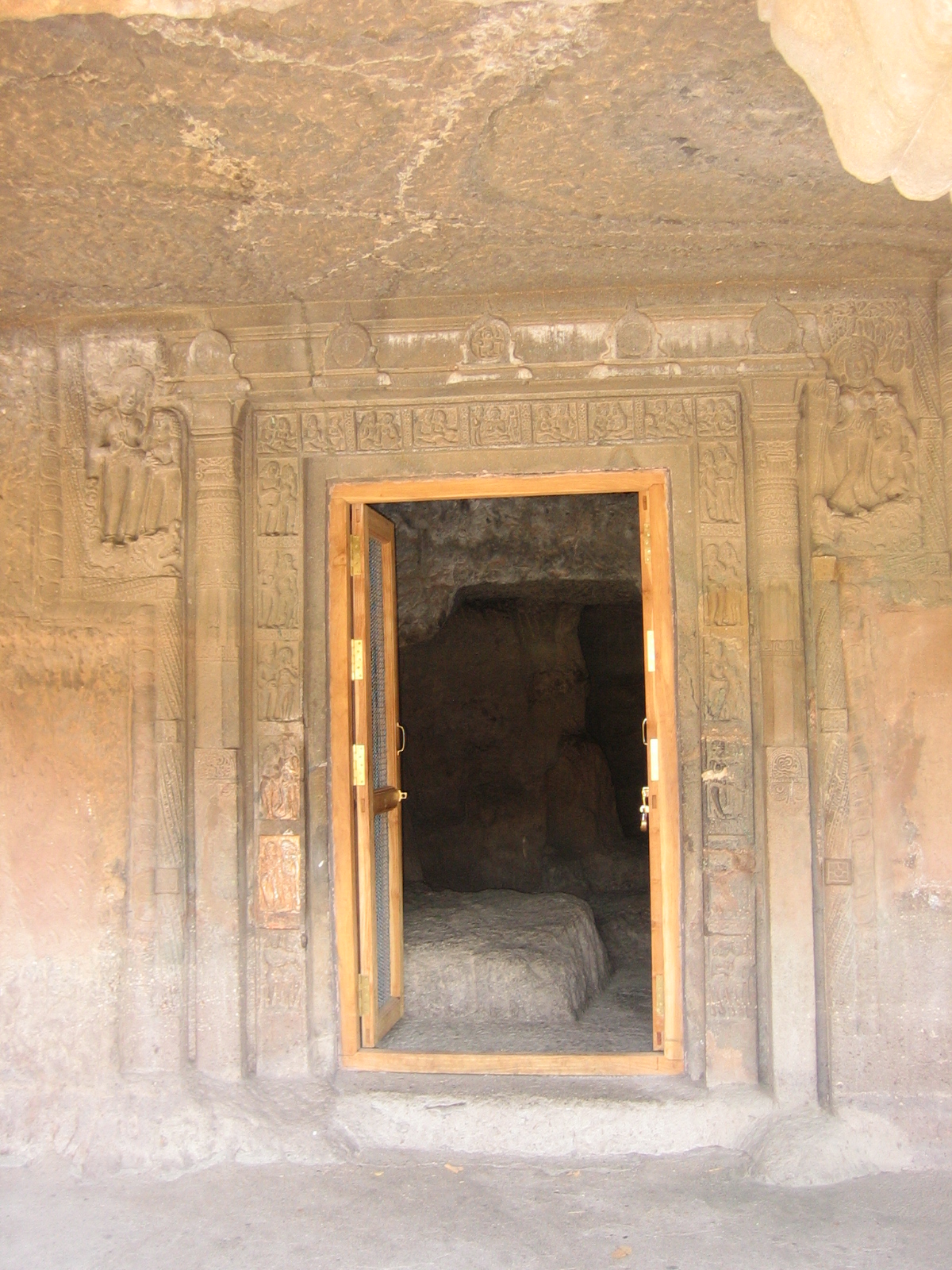
Entrance to Cave 1.
It didn't take long for me to be blown away and this event occurred about 10 seconds after entering Cave 1.  On the wall to the left of the entrance, under artistically dimmed and ethereal lighting, was the famous painting of Padmamani Bodhisattva, the face of Ajanta.

Padmapani Bodhisattva as
poorly photographed with my
camera.
The Padmapani Bodhisattva
mural as it felt to me; warm
and radiant.


Do you know that feeling when you've seen a famous painting or sculpture in a book or on TV and then you go to a museum and see this work in real life and think "Hey I know this!"?  My experience with the Padmapani Bodhisattva mural was nothing like that at all.  For me, this imagine wasn't merely a famous pretty painting on a cave wall.  It was so many things to me, all at once; a welcome home sign, a devotional image, a model for the human potential, a figure of serenity surrounded by hectic activity, an elegant and delicate yet enduring expression of compassion from people in an age long past but so profoundly relevant today.  I'll stop there since going on further would quickly lead me to the realm of speechlessness and inexpressibility.  If you're interested in a more detailed art analysis of this and the many other paintings of Ajanta, I highly recommend this wonderful NatGeo series as well as the the book "The Ajanta Caves", both by the amazing photographer Benoy K. Behl.

Inside Cave 2.
There was a steady stream of visitors at the caves, particularly at those closer to the main entrance.  While the periods of louder noise were a bit jarring, the moments when people were quiet or, even better, when no one else was around, were quite serene.  It wasn't hard to see the genius of Ajanta as a spiritual refuge. The sculptures, paintings, the caves, the lighting, and everything else came together as the perfect place for meditation and contemplation.


A wider shot of Cave 4.


For all of their beauty and elegance, I also felt the caves exuded a no-nonsense approach to the spiritual path.  It was almost as if the rows of buddhas and bodhisattvas on the walls were saying "please step in to my office and have a seat.  We have some business to discuss".  In the Zen tradition, to be a part of a Sangha and to practice is called "taking care of the family business", i.e. the business of enlightened beings.  In keeping with this idea, the prayer beads used in Zen and other East Asian traditions are threaded with a red cord, meant to symbolize the (spiritual) bloodline or lineage.  This recollection has often been a source of much strength and encouragement for me over the years.


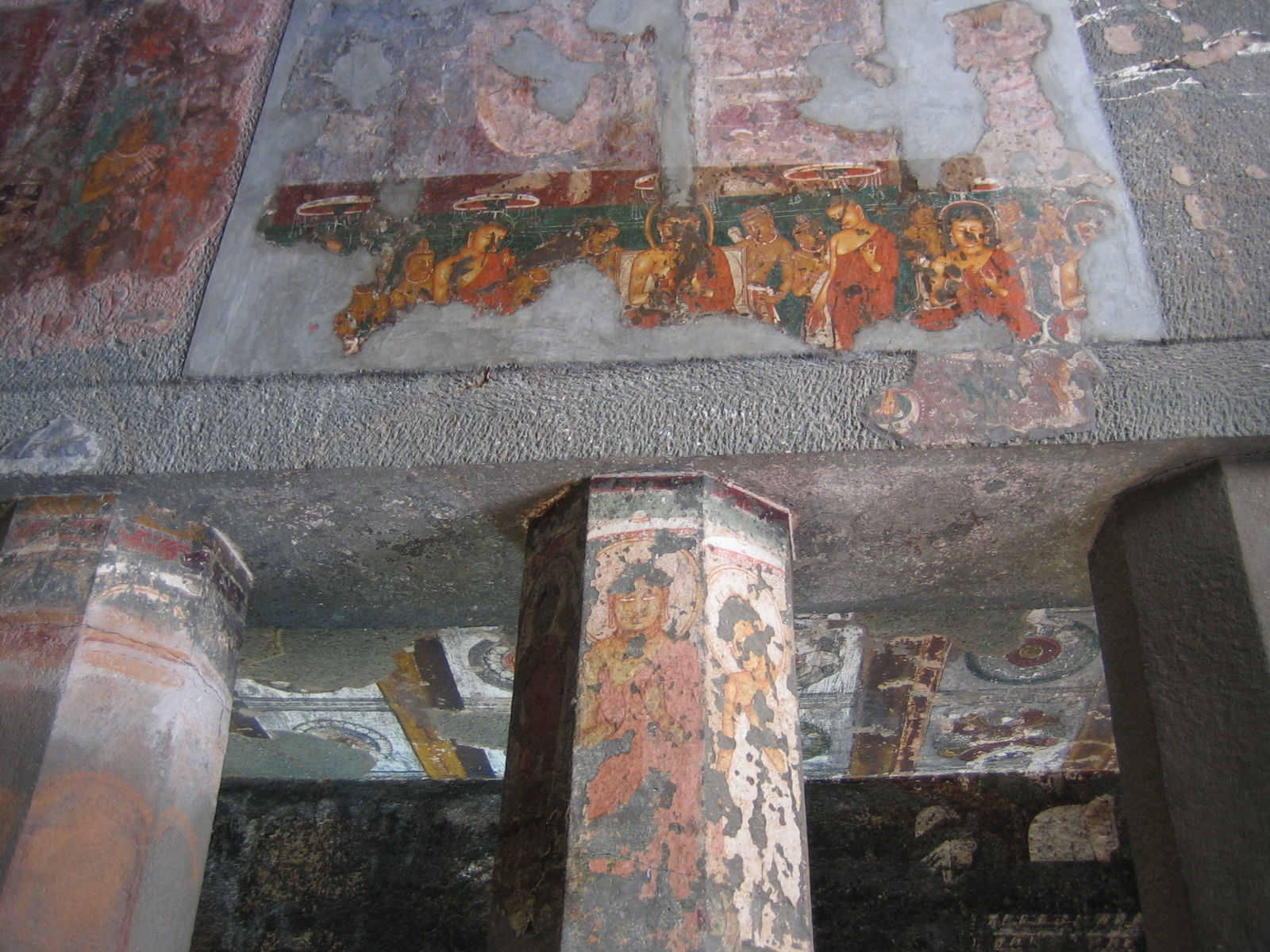
Paintings inside of Cave 9, one of Ajanta's
oldest. 
Entrance to Cave 10, the
one spotted and entered
by Capt. John Smith.


It's one thing to stroll into a world-class museum and see some lovely paintings by a Renaissance master but it's quite another to view paintings that are thousands of years old in their original setting.  Although time has clearly taken its toll on some of them, I still think it's a miracle that ANY of paintings managed to survive.  The paintings inside of Cave 10, some of which are pictured, were especially vivid.  Looking into the eyes of the painted figures really made me feel as if I were looking not just at an image but into a portal through time and space. 


A view from about half-way through the site.


A front shot of The Viewpoint,
at the top of the hill.


At first, I found the presence of rowdy kids to be very disturbing but as we slowly made our way to the other end of the site, part of me couldn't help but feel like a kid exploring some new, giant playground.  With the steps leading up, down, and around, not knowing what exactly to expect around the corner, and the anticipation of discovering the contents of a new cave, how could I not feel 12 years old?  My silent annoyance had given way to a child-like lightheartedness.


Rather than give a detailed account of each cave, a task far beyond the scope of this post, I'll instead skip to the last one and my favorite, Cave 26.  The cave numbering is not chronological but goes in the order from the main entrance.  Cave 26, at the western end of the site, is the last publicly accessible one.  It is also the largest and perhaps most elaborately decorated.   

Entrance to Cave 26.

A side view of Cave 26's exterior.


Walking in through a side entrance, one is greeted with a magnificent relief of a reclining buddha on one side and intricately decorated columns on the other.  On the other side of the cave wall are rows of stone buddhas reliefs, effortlessly sitting and standing in utter bliss.


The atmosphere of Cave 26 was very different from all the others.  It was not a dimly lit, cramped retreat space but rather a bright and cavernous grand hall.  And in the center of it all was a large stupa.  This cave served as a chaitya, or place of assembly for the people who lived and studied at Ajanta.  Although I hadn't come with and wasn't waiting on a big group, standing in the middle of this place did make me feel as if I were a part of something.  What did I feel a part of?  I can't say for sure, except that it felt very special.

Stupa in the middle of Cave 26.
At this point, my mother and I had seen all of the caves but there was still one place that remained to be explored, the place where Ajanta's (modern) history began: the Viewpoint.  From Cave 26 we made our way toward a path that led downward to an old bridge spanning the "river".  A clearly marked trail snaked its way up to the top.  Stopping at a middle point offered another interesting perspective on the Ajanta site.

Trail up to the Viewpoint.


From the top.
Underneath the canopy at the top, we found some much needed benches, an Indian fellow who suavely inquired if we were interested in buying "most special mineral crystals from the region", and some pleasant, chatty travelers from Korea.  Relaxing in the shade, looking at the caves, and especially noticing the many people weaving their way from one cave into another was a simultaneously relaxing and bizarre experience.  It felt relaxing because the Viewpoint, with its shade, benches, and view, is just a great place to kick back.  It felt bizarre because seeing the people go in and out of the caves made me feel as if I were watching myself do the same and being aware of me watching myself, like an actor breaking the fourth wall.  Or maybe I just needed some water and to chill out a bit more.

After snapping some panorama shots, we leisurely strolled toward the exit at the main gate.  Although it was mid-afternoon, we had chosen a good time to depart since it seemed that half the population of Maharashtra state decided to visit at this time.  Before leaving, I popped in to Cave 1 for a last look at Padmapani Bodhisattva.  With a reverent sentiment of farewell, I walked out with a smile on my face and the feeling that at some point I will return.  There is, after all, much business to attend to.